

What if the success of your hair restoration depended less on the surgeon's hands and more on the precision of the administrative system supporting them? While technical skill is vital, the hair transplant patient experience is defined by the logistical framework that manages every graft from extraction to aftercare. Most patients feel a mix of anticipation and significant anxiety regarding surgical discomfort or the complexity of planning a procedure in the UK. It's natural to feel overwhelmed by the choice between FUE and DHI techniques or the coordination required for a successful recovery.
This guide provides a structured breakdown of exactly what you'll encounter during your restoration journey, ensuring you move forward with clinical certainty rather than guesswork. We'll examine the specific surgical stages, the safety protocols that protect your health, and the systematic roadmap necessary for achieving optimal post-operative results. By the end of this article, you'll have a clear understanding of how clinical excellence and methodical coordination combine to deliver a predictable, high-quality outcome.
Key Takeaways
- Understand why professional oversight within a CQC-regulated environment is essential for maintaining clinical safety standards throughout your journey.
- Learn the operational details of the surgical day, including the management of local anaesthesia and the precise timeline for graft implantation.
- Discover how administrative coordination and dedicated logistical support enhance the hair transplant patient experience by streamlining the communication between you and the surgical team.
- Gain a structured recovery roadmap that explains how to manage the critical first 48 hours and the subsequent shedding phase.
- Identify the importance of systematic aftercare management in securing stable and predictable long-term restoration results.
Defining the Modern Hair Transplant Patient Experience
The modern hair transplant patient experience is an integrated, multi-stage journey that extends far beyond the operating theatre. It begins with a detailed clinical consultation, progresses through a precisely managed surgical day, and concludes with a structured aftercare programme. This systematic approach ensures that every phase is handled with medical rigour. While many patients initially experience anxiety regarding surgical outcomes or logistical planning, a well-organised clinical pathway transforms this uncertainty into post-operative confidence. It's about moving from a state of hair loss concern to a position of informed control.
In the UK, this experience is defined by professional oversight and clear accountability. This contrasts sharply with the "medical tourism" model often found abroad, where the focus frequently shifts from patient welfare to high-volume turnover. Overseas packages might appear cost-effective, but they often lack the continuous clinical supervision required for long-term success. A domestic, CQC-regulated journey provides the stability and transparency that international, technician-led clinics cannot guarantee. When you choose a regulated path, you're prioritising safety over convenience.
The Pillars of a Positive Clinical Outcome
Clinical safety depends entirely on the expertise of GMC-registered surgeons who oversee the entire extraction and implantation process. Technical precision is achieved through modern hair transplantation techniques such as Sapphire FUE and DHI. These methods allow for higher density and more natural-looking hairlines by using specialised tools for graft placement. Administrative clarity also plays a vital role in the hair transplant patient experience. When communication is transparent and schedules are fixed, patient stress levels drop significantly, allowing the focus to remain on the physical recovery.
Why Regulation Matters for Your Peace of Mind
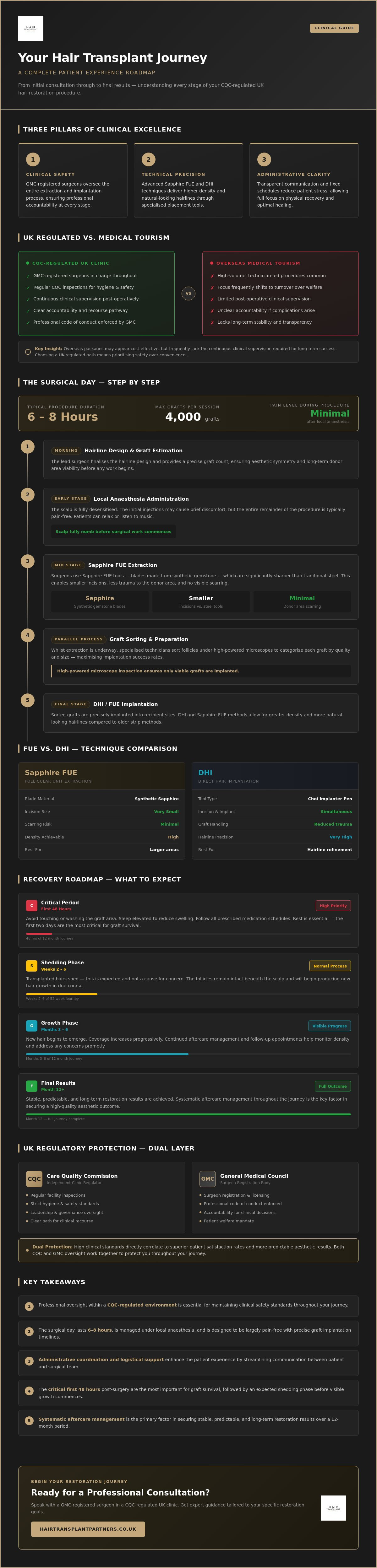
The Care Quality Commission (CQC) provides the essential regulatory framework for UK clinics. They ensure that facilities meet strict hygiene, safety, and leadership standards through regular inspections. Accountability is further reinforced by the General Medical Council (GMC), which mandates that surgeons adhere to a professional code of conduct. This dual layer of protection means that if issues arise, there's a clear path for recourse and clinical correction. High clinical standards directly correlate to superior patient satisfaction rates and more predictable aesthetic results.
The Clinical Procedure: A Step-by-Step Surgical Journey
The surgical day is a methodical process designed for patient comfort and technical accuracy. Most procedures last between 6 and 8 hours; however, the exact duration depends on the total graft count required for your specific restoration goals. The morning begins with the administration of local anaesthesia. This numbing phase ensures the scalp is completely desensitised before the surgical work commences. While the initial injections may cause brief discomfort, the remainder of the hair transplant patient experience is typically pain-free, allowing patients to relax or listen to music during the session. Understanding what to expect after a hair transplant and during the procedure helps reduce anxiety and promotes a smoother clinical journey.
Once the scalp is fully numbed, the extraction phase begins. Surgeons utilise Sapphire FUE tools, which feature blades made from synthetic gemstone. These instruments are significantly sharper and more precise than traditional steel tools, allowing for smaller incisions that minimise trauma to the donor area. This precision is essential for ensuring that the surrounding hair follicles remain healthy and the donor site heals without visible scarring. The focus here is on efficiency and the preservation of your natural hair density.
Preparation and Initial Extraction
Before any extraction begins, the lead surgeon finalises the hairline design and provides a precise graft estimation. This stage is critical for ensuring aesthetic symmetry and long-term donor area viability. Surgeons typically aim to extract up to 4,000 grafts in a single session to avoid over-harvesting and to maintain the health of the donor site. During this time, the surgical team operates with high levels of coordination:
- Graft Sorting: Specialised technicians sort follicles under high-powered microscopes to categorise them by hair count.
- Follicle Protection: Extracted grafts are stored in a chilled, nutrient-rich solution to maintain their viability outside the body.
- Safety Monitoring: The clinical team monitors your vital signs and comfort levels throughout the extraction process.
Creating Channels and Implantation
The implantation phase utilises either Sapphire FUE or DHI techniques to achieve natural-looking density and correct hair direction. Sapphire FUE involves creating micro-channels with gemstone blades, which produce cleaner incisions and facilitate a quicker healing process. Alternatively, DHI (Direct Hair Implantation) uses a Choi pen tool for a "no-channel" approach. This allows the surgeon to control the depth, angle, and direction of each follicle with extreme precision. Many clinics integrate Platelet-Rich Plasma (PRP) treatment during this phase to stimulate follicle survival and accelerate the body's natural healing response. To determine which technique suits your specific hair loss pattern, you can use a Graft Calculator to estimate your requirements and plan your surgery with precision.
Navigating Logistics: Why Coordination Defines the Experience
Logistics often dictate the success of the hair transplant patient experience long before the first incision is made. While clinical skill is the foundation of restoration, the administrative framework provides the stability required for a patient to feel secure. Many individuals face "information overload" when planning their procedure, struggling to balance medical history reviews with work commitments and travel arrangements. A dedicated coordinator eliminates this confusion by acting as a single, authoritative point of contact for every administrative query.
Professional coordination bridges the gap between the patient and the surgical team. It ensures that the surgeon's clinical focus remains on the procedure whilst the patient's logistical needs are handled by a specialist. This division of labour creates a more efficient environment, where data is tracked accurately and timelines are strictly maintained. Without this oversight, the transition from initial enquiry to the operating theatre can feel fragmented and stressful. By centralising communication, the process remains transparent and highly organised.
The Role of an Appointment Manager
A professional appointment manager serves as the logistical backbone of the entire restoration process. They are responsible for organising consultations and fixing surgery dates that align with clinical availability and patient requirements. Their role includes streamlining pre-operative requirements, such as blood tests and medical history reviews, ensuring no detail is overlooked before the surgical day. They also manage the critical transition from the initial Graft Calculator estimate to a formal clinical diagnosis. This ensures that the surgical team is fully prepared for the specific density and graft count required to achieve the desired aesthetic outcome.
Streamlining the UK Patient Journey
In the UK market, a structured approach is essential for maintaining CQC-regulated standards and patient safety. This involves organising a series of follow-up appointments and post-operative check-ins to monitor healing progress systematically. Patients receive a comprehensive "patient pack" containing clear instructions, emergency contact details, and a recovery timeline. This level of detail removes the guesswork from the post-operative phase and ensures that recovery milestones are met. Systematic logistical coordination reduces surgical cancellations by ensuring all pre-operative medical clearances are confirmed well in advance. By centralising these tasks, the hair transplant patient experience becomes a predictable, well-defined roadmap rather than a series of disconnected events.
Post-Operative Management: From Recovery to Final Results
The hair transplant patient experience doesn't conclude at the end of the surgical session; it transitions into a structured, long-term recovery phase. Successful restoration depends on the careful management of the newly implanted grafts during their most vulnerable period. The first 48 hours are particularly critical, as the follicles haven't yet established a stable blood supply. Precise adherence to clinical instructions during this window is the primary factor in determining the final graft survival rate. It's a phase that requires patience and a methodical approach to daily care.
Expectations must be managed carefully during the first three months, often referred to as the "shedding phase." During this time, the transplanted hair shafts naturally fall out, which can cause temporary concern for many patients. However, this is a standard physiological response. The follicles remain healthy beneath the skin, preparing for the growth cycle that begins in earnest around month four. By the six-month mark, approximately 50% of the final density is usually visible, with the full aesthetic result typically achieved between 12 and 18 months post-surgery.
The Critical First Week
The first seven days of recovery focus on graft security and scalp healing. You'll receive specific washing instructions that involve gentle dabbing rather than rubbing to prevent graft displacement. Physical strain, including heavy lifting or intense cardiovascular exercise, must be avoided to keep scalp blood pressure stable. Swelling around the forehead and eyes is a common side effect but can be managed effectively with specialised aftercare products and sleeping in an upright position. A scheduled post-operative review at the end of this week allows the clinical team to confirm that the healing process is proceeding correctly.
Achieving and Maintaining Density
For patients who have undergone extensive restoration, such as the placement of 4,000 grafts, the settlement period is essential for a full, natural appearance. Achieving this result is a gradual process that requires consistent monitoring. Many patients choose to integrate ongoing PRP therapy into their routine to support follicle longevity and maintain the health of native hair surrounding the transplant area. Tracking these milestones is significantly easier when you have a structured system in place. To ensure your recovery is handled with clinical rigour, you can utilise professional Aftercare Management to monitor your progress and secure your long-term results.
Strategic Planning: Your Restoration Roadmap with Professional Partners
A superior hair transplant patient experience is the result of merging clinical surgical excellence with methodical administrative coordination. When these two elements work in unison, the risks associated with fragmented care or unregulated medical tourism are eliminated. Hair Transplant Partners UK facilitates access to leading UK clinics that adhere to the highest regulatory standards. This approach ensures that every patient receives a structured roadmap rather than a series of disconnected medical appointments. Accurate planning begins with a commitment to transparency and data-driven decision-making.
The partnership model functions as a stabilizing force throughout the restoration process. It provides a framework where medical expertise is supported by logistical precision. By centralising the management of your journey, you ensure that no detail is overlooked, from the initial graft estimation to the final 12-month review. This systematic oversight is what distinguishes a professional clinical outcome from a standard procedure. It's about building a foundation of trust through organized, reliable information.
Evaluating the Value of UK Restoration
When evaluating the hair transplant cost UK, it's vital to consider the long-term security provided by local aftercare. While overseas options might present a lower initial price, they often lack the accountability of a CQC-regulated environment. An "all-inclusive" coordination model provides better value because it covers the entire lifecycle of the restoration journey. High-quality surgical partners are identified by their registration with the GMC and their willingness to provide a clear, fixed timeline for results. Security and proximity to your clinical team are essential for managing any post-operative queries effectively.
Next Steps in Your Journey
Taking the first step requires moving from general research to specific data. You can use a graft calculator to generate an initial estimate based on your hair loss pattern. This data provides a baseline for your conversation with a specialist hair restoration coordinator. This transition from digital research to clinical reality is a pivotal moment in the hair transplant patient experience. Preparing a list of specific questions regarding surgical techniques and recovery timelines will ensure your consultation is productive. Booking a complimentary initial consultation allows you to receive a bespoke surgical plan tailored to your unique physiology.
To ensure you're prepared for the journey ahead, consider this final checklist:
- Verify Registration: Confirm the CQC registration of your chosen facility and the GMC status of your surgeon.
- Review the Programme: Ensure you have a copy of the structured aftercare programme and recovery timeline.
- Fix Your Dates: Use the appointment manager to secure your consultation and surgical dates well in advance.
- Prepare Questions: List your concerns regarding FUE vs DHI techniques for your coordinator to address.
- Establish Contact: Confirm you have a single point of contact for all administrative and clinical queries.
Securing Your Long-Term Hair Restoration Results
Achieving a successful outcome requires more than technical precision during surgery. It depends on a systematic approach that integrates CQC-regulated clinical standards with meticulous personal coordination. By following a structured roadmap, you ensure that every phase, from the initial extraction of up to 4,000 grafts to the final aftercare review, is managed with professional oversight. This methodical framework is what defines a high-quality hair transplant patient experience in the United Kingdom.
When you partner with experts who prioritise GMC-registered surgeons and comprehensive aftercare management, you eliminate the risks associated with fragmented care. You'll move forward with a clear understanding of your recovery timeline and the confidence that your results are being tracked by specialists. It's time to transition from uncertainty to a position of informed action. Book your complimentary consultation with a personal coordinator today and begin your journey toward predictable, high-density results. We are ready to manage your restoration with clinical precision.
Frequently Asked Questions
How painful is the hair transplant patient experience during surgery?
The primary source of discomfort is the administration of local anaesthesia at the start of the procedure. Once the scalp is fully numbed, you won't feel any sharp pain during the extraction or implantation phases. Most patients report feeling only mild pressure or a tugging sensation as the surgical team works. The clinical environment is designed to be relaxing, and you'll be able to listen to music or rest throughout the session.
What is the most difficult part of the hair transplant recovery journey?
Many individuals find the "shedding phase" between weeks three and twelve to be the most challenging aspect of the hair transplant patient experience. This is a natural physiological response where the transplanted hair shafts fall out before the new growth begins. While it can cause temporary anxiety, it's a standard part of the follicle's life cycle. Physically, the first 48 hours require the most discipline, as you must sleep in an upright position to prevent graft displacement and manage facial swelling.
How long do I need to take off work after a hair transplant procedure?
Most patients choose to take 7 to 10 days off work to allow for initial healing and for visible scabbing to subside. If your role is desk-based and you aren't concerned about the aesthetic appearance of the donor area, you could technically return after 3 or 4 days. However, those in physically demanding jobs involving heavy lifting or dusty environments must wait at least 14 days to protect the scalp from infection and blood pressure spikes.
Can I drive myself home after the hair restoration surgery?
You shouldn't drive yourself home immediately following the procedure. Although local anaesthesia is used rather than general sedation, a 6 to 8 hour surgery is physically exhausting and can affect your concentration levels. Some clinics also provide mild oral sedatives to help you relax during the day, which makes driving unsafe. We recommend arranging a taxi or having a friend or family member collect you from the clinic.
What happens if I am not happy with the density of my results after 12 months?
A formal clinical review is conducted at the 12-month mark to assess the final density against the initial surgical plan. If the results don't meet the predicted benchmarks, the surgeon will investigate the underlying causes, such as graft survival rates or ongoing native hair loss. Having a structured aftercare management system in place ensures that your progress is tracked monthly, allowing for early interventions if the healing process deviates from the expected roadmap.
How does an appointment manager help during the hair transplant process?
An appointment manager serves as your logistical lead, ensuring all administrative tasks are completed without delaying your surgery. They coordinate your initial consultations, manage the collection of your medical history, and ensure your pre-operative blood tests are reviewed by the surgical team. This professional oversight streamlines the hair transplant patient experience by removing the burden of coordination from the patient and centralising all communication through a single point of contact.
Is the patient experience different for FUE versus DHI techniques?
The surgical experience is very similar for both techniques, though the implantation phase differs in its technical execution. FUE involves creating micro-channels in the scalp before placing the grafts, whereas DHI utilises a specialised Choi pen to implant the follicles directly. DHI can sometimes offer a more discreet recovery for smaller graft counts because it doesn't always require a full shave of the recipient area. Your coordinator will help you determine which method aligns with your density requirements and lifestyle needs.
What should I avoid doing in the first week after my hair transplant?
You must avoid any activity that increases blood pressure or risks physical contact with the recipient area. This includes heavy exercise, swimming, direct sunlight, and wearing tight-fitting hats or helmets. It's also vital that you don't scratch or pick at the scabs that form around the grafts, as this can lead to permanent follicle damage or infection. Following the specific washing programme provided in your patient pack is the best way to keep the area clean without causing trauma.